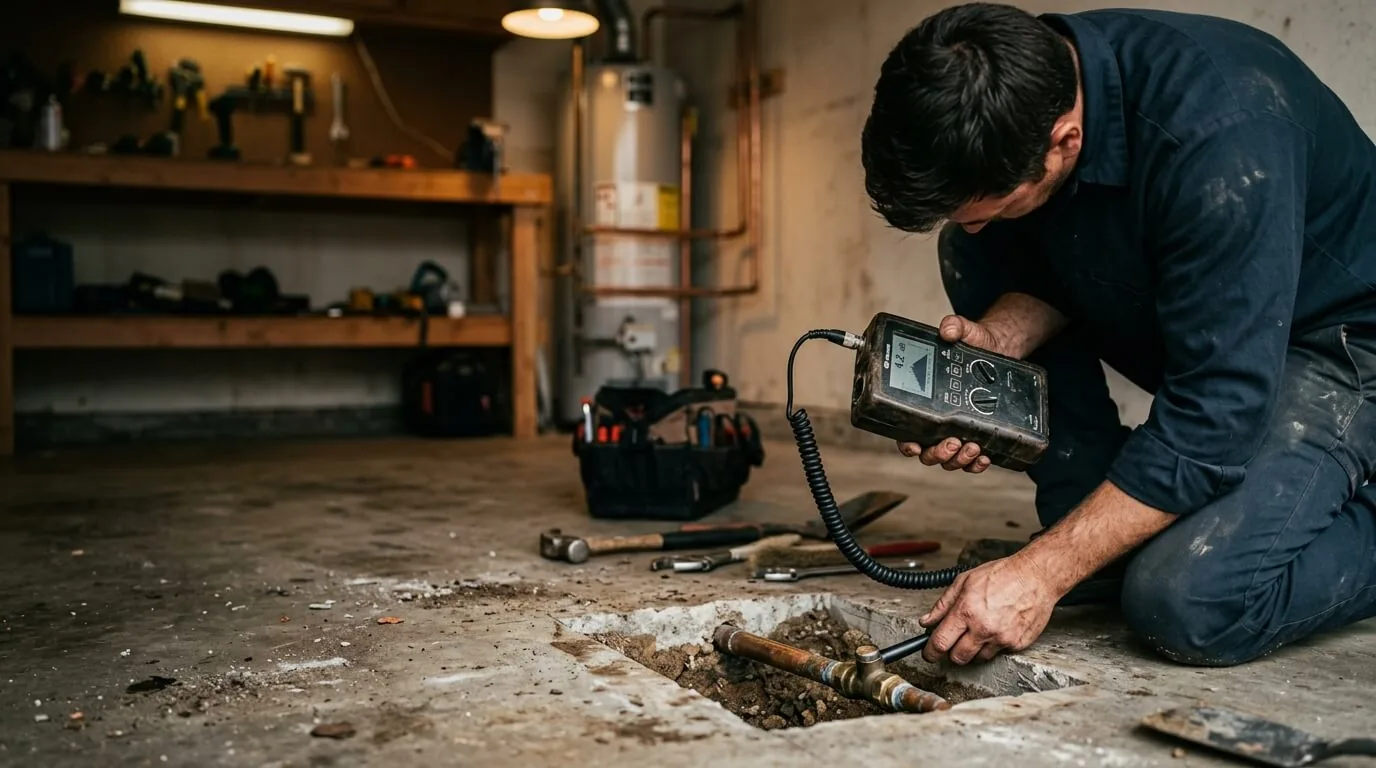
Water escaping a pressurized pipe under your concrete foundation. Our technicians pinpoint the exact leak location with electronic detection, walk you through every repair option with a written quote, and open the smallest area the job allows. Call (858) 599-0256 and we will get a truck scheduled today.
Slab leak repair Riverside CA is the process of locating and fixing a broken water line under your concrete foundation. Sunrise Plumbing Riverside finds the leak with electronic detection, then repairs it by spot repair, pipe reroute, or repipe. Licensed since 2011, we quote every option in writing before any work starts.
Warning Signs
A slab leak hides itself for weeks before it shows. Water follows the path of least resistance through soil and concrete, so the wet spot rarely sits above the break. Watch for these signals.
Shut every fixture and appliance that uses water, then look at the dial on your water meter. Movement with everything off means water is leaving the system somewhere, and under the slab is a common answer in Riverside homes built on expansive clay soil.
Detection
Guesswork gets expensive fast, because every wrong guess is another hole in your floor. Our detection work narrows the leak to a small target before a single tool touches concrete.
We close off sections of the supply system and pressurize them. Watching which section loses pressure tells us whether the leak sits on the hot line, the cold line, or outside the slab entirely.
Ground microphones amplify the hiss of water escaping a pressurized pipe through soil and concrete. Moving the sensor across the floor in a grid gives us the loudest point.
Pipe locating equipment maps the run of the line under the slab so we know exactly what we are cutting toward and what we should avoid.
Baseboards, cabinet bases, and the slab perimeter tell us how far moisture has traveled.
Detection results go to you before repair begins. You see where the leak is, what caused it, and which repair options fit, and then you decide.
Your Options
Most slab leaks can be solved three different ways. None of them is automatically right, so we price the ones that genuinely apply to your house.
We cut a controlled opening in the concrete directly above the leak, remove the failed section of pipe, install new pipe, pressure test the line, then backfill and patch the concrete. Suits a single leak in a newer home where the rest of the piping is sound — the fastest route back to normal water service.
Instead of chasing a line under concrete, we abandon and cap the damaged section, then run a new line through walls, a ceiling, or the attic. Makes sense when the leak sits under a kitchen island, a load bearing area, or expensive flooring. The old pipe stays buried and dry.
When a slab has leaked more than once, or the original galvanized steel and older copper is failing throughout, repairing one spot buys very little time. A repipe takes the slab out of the equation permanently. We show both quotes side by side so the comparison is yours to make.
The line that fails changes what you feel and what we do. Hot water leaks announce themselves with a warm floor patch and a water heater that cycles far more than it should, because heated water is being pushed into soil around the clock. Cold line leaks stay silent longer and usually show up first as a high bill or damp flooring.
Hot lines also fail more often, since heat accelerates corrosion and the pipe expands and contracts against concrete every time somebody runs a shower. Telling you which line is leaking is part of detection, and it drives the repair recommendation, because a hot line under a bathroom is often the strongest candidate for a reroute.
What to Expect
Nobody wants a surprise about their floor, so here is the plain version. Spot repair means cutting an opening in the slab, and that opening is only as large as the repair needs. Furniture gets moved and the work area gets covered before cutting starts. When the new pipe passes its pressure test, we backfill the trench, pour concrete back to slab level, and leave the patch ready for finish flooring.
Replacing the tile, wood, or carpet over that patch is finish work, and we will tell you clearly at quote time what our scope covers and where a flooring installer takes over. Choosing a reroute avoids the cut altogether, which is exactly why we price both.
Process
Describe what you are seeing and we book a visit, with priority given to active water damage.
A technician checks the meter, fixtures, water heater, pressure, and every damp area to confirm the leak is under the slab and not somewhere easier.
Isolation, pressure testing, and electronic detection narrow the location to a small target rather than a room.
You get each viable repair path in writing with what it involves. Approval happens before tools come out.
We protect the work area, complete the spot repair, reroute, or repipe, and keep you posted as the job moves.
New pipe is pressurized and held before anything gets closed up. Meter readings confirm the loss has stopped.
Concrete gets patched where it was cut, access holes get closed, and the site gets cleaned before we leave.
Homeowners hesitate on slab leaks for one reason. They fear a plumber will jackhammer the living room, guess wrong, then cut again. That fear is fair, and it is why we do not cut until detection gives us a specific target, and why the reroute option is priced next to the spot repair rather than hidden. Every option comes with what it involves and what it costs before you approve anything. Call (858) 599-0256 and get the diagnosis first.
Why Choose Us
CSLB California plumbing license, verified technicians. We work Riverside daily, so we know how homes here are built and how local soil behaves.
Finding the leak precisely is the whole job. Cutting is just what follows.
Spot repair, reroute, and repipe get compared for your specific house.
You approve a number before work starts, and the scope is spelled out.
Detection, concrete work, repiping, and pressure testing are handled by the same team, so nothing gets handed off mid job.
Work areas get covered, and the site gets cleaned before we leave.
Pricing
Pricing is quote based, and for good reason. Two houses with the same symptom can need very different work.
These factors drive your number:
You get an exact figure after detection, in writing, with each option listed. Publishing a fake average would only mislead you, so we quote the house in front of us.
Get Your Estimate · Call (858) 599-0256Prevention starts with water pressure. High incoming pressure stresses every joint in the system, and a working pressure regulator is the cheapest protection your plumbing has. Hard water accelerates corrosion from the inside, so softening or conditioning helps older copper last. Keep an eye on your bill month to month, since a rising baseline is the earliest warning a slab leak gives. Ask us to check pressure and pipe condition while we are already on site.
Coverage
Our trucks cover Riverside and the surrounding Inland Empire, including Canyon Crest, the Wood Streets, Downtown Riverside, Magnolia Center, La Sierra, Arlanza, Casa Blanca, Orangecrest, Mission Grove, Hawarden Hills, Victoria, Woodcrest, and Sycamore Canyon, across ZIP codes 92501, 92503, 92504, 92505, 92506, 92507, and 92508.
FAQ
Coverage depends on your policy. Many policies help with sudden water damage to the home while excluding the pipe repair itself, and gradual deterioration is commonly excluded. Call your insurer as soon as you suspect a leak, and ask what documentation they want. We can provide our findings and invoice for your claim.
Not always. A spot repair does require a controlled opening in the concrete, while a reroute runs new pipe through walls or attic space and leaves the slab intact. We tell you which option applies after detection, and the choice stays yours.
Detection usually takes a few hours. Simple spot repairs are often finished the same day, while a reroute or repipe can run longer depending on how many fixtures are involved and how much access there is. Concrete patching adds curing time after the plumbing is done.
Leaving it costs more later. Water under a slab erodes the soil that supports your foundation, soaks flooring and framing, feeds mold growth, and keeps billing you every month. Acting early keeps the repair small.
Expansive clay soil shifts and stresses rigid pipe. Corrosion from hard water thins pipe walls from inside. Abrasion against concrete wears a pipe over decades, and high water pressure or an original installation flaw makes any of those fail sooner.
One leak in an otherwise healthy system points to a repair. Repeat leaks, aging galvanized steel, or pressure loss at several fixtures point to a repipe. Both quotes get put in front of you so the math is visible.
Still Deciding? Get the Diagnosis First
What you need is to know where the leak is and what it will take. Book the detection visit, get your written options, and choose from there.
Call (858) 599-0256 to Schedule Detection